
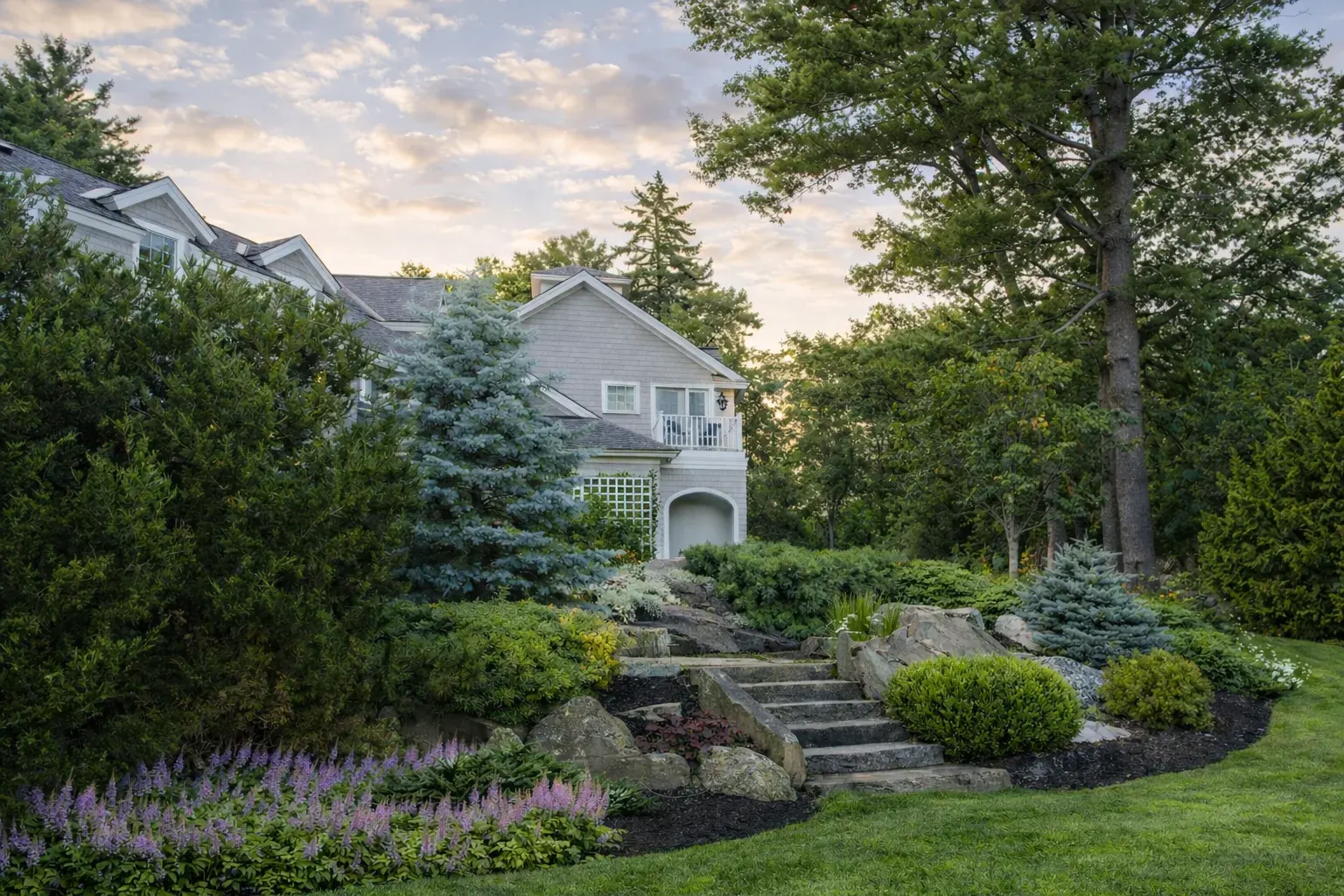
Landscape drainage problems happen when water does not soak in, move across, or move away from your yard the way it should. The annoying part is that the problem usually starts small: a puddle by the walkway after a hard Lakes Region rain, a lawn that still feels squishy the next afternoon, or mulch that keeps sliding out of the same bed.
What a landscape drainage problem actually looks like
A drainage problem is not just “a wet yard.” Your landscape is supposed to hold some moisture, especially after a storm, spring thaw, or a day of steady rain. The problem starts when water hangs around too long or rushes through the wrong areas fast enough to cause damage.
Think of your yard like a kitchen sink. Water should move through it and away from it in a controlled way. If the sink fills up and just sits there, that is one kind of problem. If the water sprays over the edge and runs across the counter, that is another. Both point to drainage trouble.
In real life, this often shows up in small, easy-to-ignore ways first. A low spot near the patio stays wet. A bed along the driveway keeps losing mulch. A patch of grass near the back corner never seems to bounce back. On a sloped lot in places like Moultonborough, Meredith, or Gilford, a single hard summer downpour can make the pattern obvious fast.
The most common signs your landscape has a drainage problem
One sign alone can be enough to take seriously. Several signs showing up together usually confirm that your yard is not handling water well.
Puddles that stick around long after rain
A puddle during a storm is normal. A puddle that is still sitting in the lawn, planting bed, beside the driveway, or along the patio long after the rain stops is not.
That lingering water means one of two things, and sometimes both. Either the area is too low and collects runoff like a bowl, or the soil underneath is draining so slowly that the water has nowhere to go. If the same spots fill up after every storm, your yard is giving you a very clear message.
Soggy soil and squishy spots underfoot
You know the feeling. You step off the walkway or start mowing and your shoe sinks into the same wet patch again. A day later, it is still soft. Sometimes it looks muddy. Sometimes it just feels spongey underfoot.
That kind of waterlogged ground is a classic warning sign. Even when there is no visible standing water, saturated soil can still be holding too much moisture for healthy turf and plant roots.
Grass and plants that turn yellow, thin out, or die back
Too much water can hurt plants just as much as too little. Roots need oxygen in the soil, and soaked soil pushes that air out. The result is grass that yellows, thins, or dies back in patches, plus shrubs and perennials that never seem to really take off.
Here’s the thing: this often fools people. If you are “watering enough” and your plants still look stressed, the issue may not be lack of water at all. It may be roots sitting in wet soil for too long, which can lead to root rot and slow decline.
Soil washing away or visible runoff paths
Not all drainage problems look swampy. Some look like movement.
If mulch keeps drifting downhill, gravel washes out of place, roots become exposed, or you can see little channels carved through bare soil, runoff is moving too fast across the surface. Fast-moving water is still a drainage problem, just a different kind. Instead of sitting still, it is carrying parts of your landscape with it.
Water where it should not be near your home or hardscape
Pooling near your foundation is a bigger deal than a soggy back corner. Water collecting against the house, around retaining walls, or along the edge of a patio can lead to much more than muddy shoes.
You may notice damp basement signs, slick walkways, pavers that shift or heave, or staining on masonry and concrete. Once water starts affecting hard surfaces and structures, repairs usually get more expensive and more disruptive.
Mosquitoes, mold, mildew, or algae showing up
Lingering moisture creates the perfect setup for things you do not want around. Mosquitoes love standing water. Mold and mildew thrive in damp, shady areas. Hard surfaces can develop a slippery green film from algae, especially in spots that never quite dry out.
If one side of your property always smells a little musty or your steps stay slick after wet weather, that is not just a maintenance issue. It often points back to drainage.
Why these signs happen in the first place
Most yard drainage issues come back to a few simple causes: slope, soil, compaction, or where runoff gets directed. Water is not complicated. It follows gravity, avoids tight soil, and piles up wherever the landscape makes that easy.
Poor grading and low spots
Grading is just the way your ground slopes. If a section of lawn dips even a little, it can collect water like a shallow bowl. That is especially common near homes, along patio edges, and in areas where past settling has changed the surface over time.
The catch is that the grade does not need to be dramatically wrong to cause a problem. A subtle low area is enough.
Compacted soil that will not let water soak in
Compacted soil is soil pressed so tightly that water and air cannot move through it well. When that happens, rain stays near the surface instead of soaking down where roots can use it.
This shows up a lot in places with heavy foot traffic, repeated mower routes, parked equipment, or snow piles through winter. By spring, those areas can behave almost like hardpan. Water hits the surface and just sits there.
Clay-heavy or slow-draining soil
Some soil types simply drain slower than others. Clay-heavy soil holds water longer because the particles are very small and packed closely together. Rain ends, but the ground still feels saturated for far too long.
That does not mean the yard is doomed. It does mean the landscape needs to be designed with that reality in mind, instead of fighting it.
Downspouts and runoff directed into the wrong places
Roof water adds up fast. If your downspouts dump next to the foundation, into a bed, across a walkway, or onto the top of a slope, one storm can overload that area in a hurry.
The same goes for sump discharge and driveway runoff. A lot of drainage headaches start with water being sent to the wrong place, then building on itself every time it rains.
Too little plant cover or failing drainage features
Bare soil erodes more easily. Sparse root systems do less to hold the ground together and help water soak in. And if you already have drainage features, clogged drain outlets, failing swales, or overwhelmed dry wells can turn an old solution into a new problem.
Water management is not set-and-forget. A system that once worked can slowly stop working if it is blocked, undersized, or neglected.
How to tell whether your yard drains normally or needs help
A healthy yard does not need to be bone dry. Especially in New Hampshire, some seasonal wetness is normal. The real question is whether the moisture clears in a reasonable time and whether the landscape stays healthy.
What healthy drainage usually looks like
Healthy drainage means rain soaks in or moves away without leaving repeat trouble behind. The lawn dries out within a sensible window. Planting beds stay moist but not swampy. Mulch mostly stays where you put it. You do not keep seeing the same puddles, slick spots, or runoff scars after every storm.
In other words, the yard recovers.
A simple at-home drainage check
The easiest test is observation. During or right after the next rain, walk the property and pay attention to where water collects, where it rushes, and where it exits. Then check again several hours later and the next day.
You can also do a basic soak test in one problem area. Dig a small hole about 12 inches deep, fill it with water, let it drain once, then fill it again and watch how long it takes to empty. If water lingers for many hours in a spot that should be usable lawn or planting space, drainage is likely part of the problem.
What can happen if you ignore drainage problems
Drainage issues do not fix themselves. In fact, they usually get more obvious, more expensive, and more annoying over time.
Damage to lawn, planting beds, and tree roots
Turf can thin out and disappear. Planting beds can lose mulch and soil. Tree and shrub roots can stay stressed long enough that decline shows up slowly, which makes the true cause easy to miss.
That slow decline is what trips people up. A shrub may look “off” for a season or two before it finally fails, even though the real problem was excess moisture all along.
Damage to hardscapes and structures
Water can undermine patios, loosen pavers, stain retaining walls, and create pressure against foundations. Freeze-thaw cycles make this worse. In the Lakes Region, that matters. Water gets into cracks or joints, temperatures drop, and the expansion starts pushing surfaces around.
Small movement turns into a repair headache faster than most people expect.
Ongoing usability problems in your outdoor space
Some drainage problems are less about visible damage and more about how your yard feels to live with. Muddy shoes at the back door. Slippery steps in the shade. Standing water where kids play or pets run. A section of lawn you basically stop using because it never dries out.
That is still a real cost. Your outdoor space becomes less usable, less comfortable, and less enjoyable.
What usually fixes landscape drainage problems
The right fix depends on what the water is doing. Is it pooling, racing downhill, overflowing from roofs, or getting trapped in compacted soil? Match the fix to the cause and the results are usually much better.
Regrading and reshaping the landscape
If water consistently settles in the same place, regrading is often the core fix. That means adjusting the slope, filling a low area, or reshaping part of the yard so water moves away instead of collecting.
Sometimes the change is modest. A few inches in the right place can completely change how water behaves.
Aeration, soil improvement, and better planting choices
When compaction or dense soil is part of the issue, lawn aeration can help open the soil so water and air can move through it better. Adding compost or other soil amendments can improve structure over time, especially in beds.
Plant choices matter too. Some areas stay moist no matter what. In those spots, using plants that tolerate local conditions is smarter than forcing something that wants dry feet.
French drains, channel drains, dry wells, and swales
These terms sound technical, but the ideas are pretty simple.
A French drain is a gravel-filled trench with pipe that collects and carries water away below ground. A channel drain is a surface drain, often used along driveways, patios, or garage edges, that catches water before it spreads. A dry well is an underground area that temporarily holds water and lets it soak into the surrounding soil. A swale is a shallow, shaped channel in the landscape that guides water across the property in a controlled way.
Each one solves a different problem. French drains help with recurring wet zones. Channel drains work where water crosses hard surfaces. Dry wells manage collected runoff. Swales are great when the landscape has room to guide water naturally.
Downspout extensions and runoff redirection
Sometimes the fix is surprisingly straightforward. If roof water is pouring into the wrong place, extending a downspout or redirecting runoff can solve a big mess without major construction.
This is one of the most overlooked causes of drainage trouble, and one of the easiest to check.
When a DIY fix is enough and when to call for help
Some drainage issues are manageable as weekend projects. Others need a full plan, especially when water is affecting structures or multiple areas at once.
Good DIY situations
A DIY fix makes sense when the problem is small, clear, and easy to reach. Clearing a clogged drain outlet, adding a downspout extension, touching up a minor low spot, or refreshing mulch and plant cover to reduce light washout can all be reasonable jobs.
The trick is being honest about the scale. If the fix is small and the result is obvious, go for it.
Signs you need a professional drainage plan
If flooding keeps returning, water is collecting near the foundation, erosion is getting worse, pavers are shifting, a retaining wall is under pressure, or a tree’s health is declining in a wet area, it is time for a bigger look.
The same goes for properties where several problems feed into each other. Water from the roof hits a bed, runs across the lawn, settles by the patio, then drains toward the house. In that situation, treating the puddle alone misses the real source.
Drainage issues in the lakes region: what to watch for locally
The Lakes Region adds a few twists. Spring thaw can saturate ground before summer storms even start. Snow piles compact soil and dump a lot of meltwater into the same areas. Shaded yards, especially under dense tree cover, stay wet longer because sun and airflow are limited.
Sloped lots are common, which means runoff can pick up speed fast. Lakefront and near-lake properties can have tighter drainage limitations too, since managing runoff matters for erosion and water quality as much as yard appearance. Add one heavy July downpour and a yard can go from “a little soft” to obviously overloaded in an afternoon.
A quick next step if you suspect a drainage problem
Try one simple thing: walk your property during the next rain or right after it ends. Look for where water sits, where it moves, and where it lands after coming off the roof, driveway, or slope.
Start with the worst spot first. If you can identify that one trouble area clearly, the rest of the drainage puzzle usually starts to make a lot more sense.
Disclaimer: This article is for general informational purposes only. It is not professional advice, a quote, or a service agreement. Conditions at your home or property may differ; contact a qualified professional for an on-site evaluation before making repair, safety, or spending decisions.