
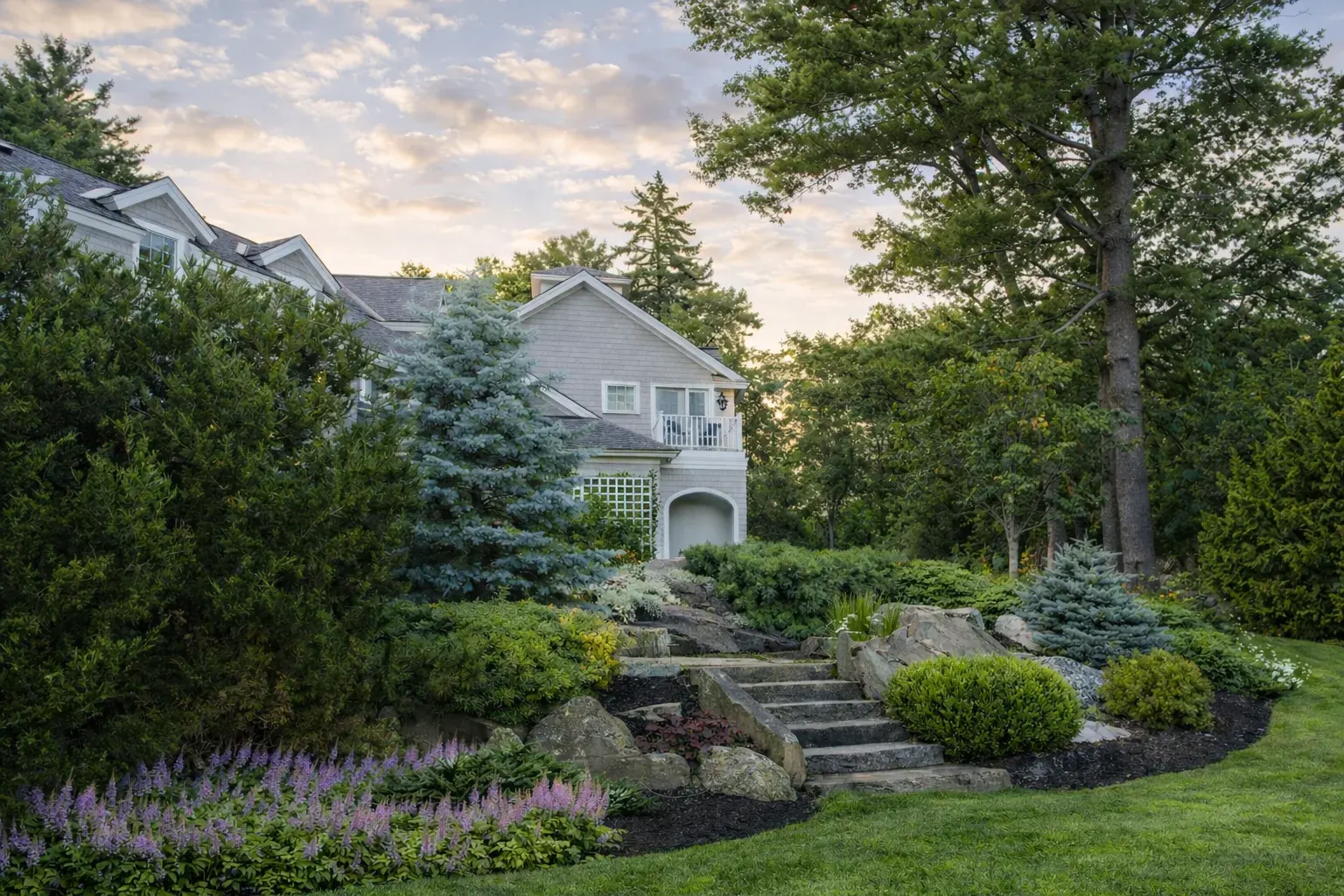
A lake view can make any property feel special, but lakefront landscaping is where the real work begins. The same slope that gives you that sunrise view can also turn into a muddy slide after a hard rain, and the same open yard that feels peaceful in May can feel exposed by July. A good lakefront plan gives you three things at once: a better-looking property, easier access to the water, and less hassle keeping it that way.
In simple terms, lakefront landscaping is the design of outdoor spaces near the water so they stay usable, attractive, and stable. That means balancing shoreline protection, drainage, access, planting, and outdoor living, especially in places like New Hampshire’s Lakes Region where weather and terrain do not give you much room for lazy decisions.
Here’s what you’ll learn in this guide:
- What makes lakefront sites different
- How to plan around real use
- Ways to protect the shoreline
- Plants that handle New Hampshire conditions
- Hardscape ideas that improve access
- Mistakes that lead to expensive redos
- Simple ways to phase the project
Start with the real goal: better views, easier access, less hassle
Most lakefront yards do not need more stuff. They need a better plan.
The problem usually shows up in familiar ways: a worn path to the dock, water washing mulch downhill, patchy grass near the shore, or a beautiful view that you only enjoy from one awkward chair on the deck. Sometimes the yard looks fine in photos but feels inconvenient in real life. You carry chairs around, guests cut through planting beds, kids run down slippery slopes, and every storm leaves a fresh mess behind.
That is why the best lakefront landscaping starts with function, not decoration. Beauty matters, of course, but beauty alone does not fix erosion, privacy, drainage, or access. Your layout should fit how you actually spend time at your property in Meredith, Wolfeboro, Moultonborough, or anywhere else around the Lakes Region. Morning coffee on a quiet patio needs a different setup than a place built for weekend boat traffic and ten people around a fire pit.
What makes lakefront landscaping different in new hampshire
A lakefront yard in New Hampshire plays by different rules than a typical inland lawn. The site often deals with slopes, rock, wind, reflected light off the water, changing moisture, and long winters that push and pull hardscape materials out of place. Add spring thaw, runoff, and occasional snow piled where you do not want it, and the margin for error gets pretty small.
Even two nearby properties can behave completely differently. One lot may drain quickly through sandy soil. The next may hold water, freeze hard, and turn slick every April. That is why copying a pretty photo from another region usually falls flat. What works beside a calm cove may fail on an exposed shoreline.
The shoreline changes the rules
The closer you get to the water, the more every choice matters. A bare patch of soil near the shoreline is not just an eyesore. It becomes a weak spot where runoff, meaning rainwater or snowmelt moving across the surface, can carry soil downhill and into the lake. That affects your property and the water itself.
Foot traffic matters more too. People naturally take the shortest route to the dock, beach, or kayak rack. If that route is too steep, too narrow, or too loose underfoot, the yard will show you exactly where the design failed. The trick is to guide movement with paths, steps, and planting, instead of fighting it later.
Local regulations and permits to check first
Before getting attached to a layout, check shoreland rules and local requirements. New Hampshire’s Comprehensive Shoreland Protection Act affects work near protected shorelines, including vegetation removal, grading, and construction. Town requirements can add another layer, especially for paths, retaining walls, docks, and setbacks.
This is not the glamorous part, but it saves headaches. If your project touches the shoreline, changes grade, removes trees, or adds structures, look into approvals first through the New Hampshire Department of Environmental Services and your town office. The smart move is to check the rules before sketching the fun stuff.
Plan around how you actually use the property
A lakefront yard should match your routine, not some catalog version of outdoor living. If your best moments happen with a mug of coffee at 6:30 on a still morning, protect that quiet corner. If your weekends revolve around swimming, grilling, and people moving between the patio and dock, build for flow.
Seasonal use matters too. A full-time home needs safer winter access, better storage, and more durable surfaces near entries. A summer property can lean harder into entertaining zones and water access. Pets, kids, older guests, and frequent visitors all change what makes a space feel easy versus annoying.
Pick your priority zones
Break the property into a few working zones: arrival, main living area, path to water, dock zone, privacy edges, and utility space. Once you do that, decisions get easier.
Your biggest investment usually belongs in the spaces you touch every day. That might mean fixing the route from the house to the dock before building a bigger patio. Or it might mean cleaning up the front arrival so the property feels pulled together from the first step out of the car. Utility areas matter too, but they do not need premium treatment. Screen the trash cans, tuck away the hose, and save the best stonework for the spaces that shape your experience.
Save the best views without leaving everything exposed
You do not need to choose between privacy and a good view. The better move is to frame the water, not wall it off.
Layered plantings work well here. Lower shrubs, ornamental grasses, and selective trees can soften the edges of a property while keeping sightlines open from key spots like the kitchen window, deck, or fire pit. Privacy belongs where you feel watched, usually from the road, neighboring homes, or side lot lines, not directly between your favorite chair and the lake.
Build a shoreline that looks natural and holds up
Erosion control is not optional on a lakefront lot. Ignore it, and the property keeps charging interest.
A shoreline can look relaxed and natural while still being stable. In fact, that usually works better than trying to force a clean suburban edge onto a site that wants to move with water, weather, and seasons.
Simple ways to reduce erosion and runoff
Start by limiting bare soil. Exposed ground is an open invitation for runoff to carry sediment downhill. Deep-rooted native plants, spreading groundcovers, shrubs, and planted buffer areas all help hold soil in place. So does shaping the land so water slows down instead of racing straight to the shore.
Mulch helps, but choose wisely. Lightweight mulch on a slope tends to travel. Stone may work in some places, but too much can look harsh and add heat. Often the best fix is a mix of planted areas, shredded bark in protected beds, and grading that directs water into the landscape rather than over it.
Naturalized shoreline vs. manicured edge
A naturalized shoreline uses layered plantings, native grasses, shrubs, and less mowed turf near the water. It generally means better soil stability, less runoff, and less weekly maintenance. It also looks more at home on a New Hampshire lake lot.
A manicured lawn-to-water edge looks tidier at first glance, but the catch is that it often creates more work and less resilience. Grass roots are shallow compared with many shoreline plants, and turf right to the water usually needs more mowing, more repair, and more cleanup after storms. If you want a polished look, keep it near the house and let the shore feel more natural.
Retaining walls, steps, and slope fixes
On steep or uneven lots, hardscape becomes part of the solution. Stone steps can make a difficult descent feel safe and obvious. Boulder walls can stabilize slopes while fitting the setting better than a formal wall system in the wrong place. Timber may seem charming, but in wet freeze-thaw conditions, it usually ages faster than stone.
The best slope work does not look overbuilt. Plants spilling around boulders, groundcovers softening stair edges, and shrubs breaking up long hard lines keep the space from feeling rigid.
Choose plants that can handle the site
Pretty plants are easy to find. Plants that survive wind, cold, moisture swings, reflected glare off the lake, and the occasional rough winter are what actually matter.
In New Hampshire, reliable plants beat fussy ones every time. If a plant needs babying to get through January, it is probably the wrong plant.
Native and lake-friendly plants that earn their keep
Native and well-adapted plants pull more weight on lakefront properties because many have stronger root systems and better tolerance for local weather. Think along the lines of switchgrass, little bluestem, winterberry, red osier dogwood, summersweet, inkberry, ferns, sedges, and hardy perennials that can handle shifting moisture.
The goal is not to turn the whole yard into a wild buffer. It is to use plants that do useful work while still looking intentional. A few dependable groupings often outperform a long list of delicate varieties.
Planting for privacy, screening, and wind break
Good screening has layers. Evergreens give year-round cover, deciduous shrubs add softness, and carefully placed trees break wind without making the property feel boxed in.
Skip the temptation to plant a solid wall of fast growers along the lake side. That usually backfires. Instead, screen where privacy is needed most and keep the water-facing side more open, with strategic plantings that frame the view instead of swallowing it.
Low-maintenance color near the lake
Color does not have to mean high-maintenance flower beds. Foliage contrast, bloom timing, bark texture, and ornamental grasses can carry a lot of visual interest with less upkeep.
A tight cluster of hydrangeas near a patio, a drift of daylilies along a path, or dark-leaved shrubs against silver-green grasses can do more than scattered beds all over the property. Like furniture in a room, placement matters more than quantity.
Hardscaping that makes the water easier to enjoy
Hardscaping is what turns a nice-looking yard into one you actually use. The path, patio, steps, and seating areas do the heavy lifting every weekend.
Materials need to handle moisture, movement, and winter. If something looks good for one season but shifts by spring, it was the wrong choice or the wrong installation.
Paths from the house to the dock or shore
The path to the water is usually the most honest part of the whole property. If it is awkward, you feel it every single time you carry a towel, cooler, paddleboard, or armful of life jackets.
Natural stone, compacted gravel, large steppers, and edged pathways all work when matched to the slope and traffic level. On steeper routes, defined steps with solid footing beat an improvised dirt track every time. Edging helps hold material in place and reduces washout after storms.
Patios, decks, and lookout spots
Not every lake lot wants one giant patio. Often a smaller sitting area in the right spot does more. A patio close to the house works well for dining and grilling, while a second overlook halfway down the slope can create a quiet place to sit near the water without crowding the shoreline.
Multi-level solutions make sense when grade changes are significant. A deck off the house, a landing with a bench, then a path to the dock can feel natural and easy to move through.
Fire pits, seating walls, and gathering spaces
A fire pit belongs where people can gather without blocking movement or fighting wind. Smoke direction matters more near the lake, especially on cool evenings when the air settles. Give the space enough room to circulate around chairs, and keep the lake as the main event instead of burying the feature in oversized hardscape.
Seating walls can save space and define an area without adding bulky furniture. They also hold up well in busy entertaining zones.
Add the finishing touches that make the space work at night
A lakefront property should still feel calm after sunset. The best finishing touches improve safety and convenience without making the yard feel busy.
Landscape lighting that stays subtle
Warm, restrained lighting works best near the water. Path lights, step lights, and gentle uplighting on a few trees help people move safely and keep the property welcoming. Dock-area lighting can be useful too, but too much brightness ruins the mood fast.
Here’s the thing: if the shoreline looks like a parking lot, the lighting plan missed the point. Less is usually better.
Storage, rinsing areas, and other smart details
Small upgrades often make the biggest difference in daily use. Bench storage near a patio, organized kayak racks, hose bibs in the right spots, discreet trash screening, and an outdoor rinse station for sandy feet or wet dogs can save a lot of annoyance.
These details are easy to overlook because they are not flashy. But on a busy summer Saturday, they are the parts you notice most.
Common lakefront landscaping mistakes to skip
Most expensive landscape fixes start as “it seemed like a good idea at the time.” A few common mistakes show up on lake properties again and again.
Too much lawn near the water
Lawn right to the shoreline usually means more runoff, more repair, and weaker holding power where the soil needs help most. It can look neat for a while, but it asks a lot from grass and gives very little back. Pull the lawn edge uphill and let planting do the work closer to the water.
Blocking views with the wrong plants
Fast-growing privacy plants in the wrong spot can erase the exact feature you paid for. Oversized shrubs near windows, dense evergreens at view lines, and foundation plantings that keep spreading all create that boxed-in feeling. Start with your sightlines, then plant around them.
Choosing materials that do not handle freeze-thaw
New Hampshire winters are rough on poorly installed pavers, cheap edging, loose steps, and shallow bases. Freeze-thaw simply means water gets in, freezes, expands, and shifts the material. By spring, the path that looked perfect in October can feel crooked and unsafe. Durable materials and proper base prep matter more than style trends.
Sample lakefront landscaping ideas by style
Style helps you make decisions faster. Once you know the overall feel you want, plant, stone, and layout choices start to line up.
Natural and wooded
This look leans into the setting instead of trying to tame it too much. Picture native plantings, irregular stone paths, boulders, grasses moving in the breeze, and a shoreline that blends softly into the lake edge. It feels relaxed, quiet, and very New Hampshire.
Clean and classic
A cleaner style uses defined beds, a tidy patio, structured shrubs, and clear access lines. You still keep the materials natural enough to suit the lake, but the layout feels sharper and more organized. This works especially well when the house already has a more traditional look.
Entertaining-focused lakefront
Some properties are built around people coming and going all weekend. In that case, prioritize a broad patio, grill space, a fire feature, easy circulation to the dock, and lighting that keeps the evening going. The trick is to support the activity without covering the whole lot in hardscape.
A smart way to phase the project
You do not need to overhaul everything at once. In fact, phased work usually leads to better decisions because the structure gets solved before the finishing touches.
Start with access, drainage, and shoreline stability
This matters more than picking flowers. If water is washing down the slope, the path is unsafe, or the shoreline is eroding, fix that first. Decorative upgrades on top of unresolved site problems are like putting a new rug over a floor that still leaks.
Add gathering spaces next
Once the site feels stable and movement works, add the spaces that change daily life most. A patio, a small overlook, better steps, or a fire pit can make the property feel transformed even before every planting bed is finished.
Finish with planting and detail work
Plants, lighting, and smaller features should come last because they tie the whole plan together. By that point, you know where people walk, where the light hits, and what still feels bare. The result looks more intentional and is usually easier to maintain.
When to bring in a lakefront landscaping professional
Some projects are simple weekend upgrades. Others really do need professional planning. Steep slopes, drainage issues, shoreline work, permits, retaining walls, and full property layouts usually go better with experienced help, especially on lakefront sites where one bad call can create years of extra maintenance.
If your property needs work in more than one area, start with one zone and get that right. The path to the dock is a great place to begin. The shoreline edge is another. Fix the part that affects your day the most, and the rest of the plan gets a lot easier to see.
Disclaimer: This article is for general informational purposes only. It is not professional advice, a quote, or a service agreement. Conditions at your home or property may differ; contact a qualified professional for an on-site evaluation before making repair, safety, or spending decisions.