
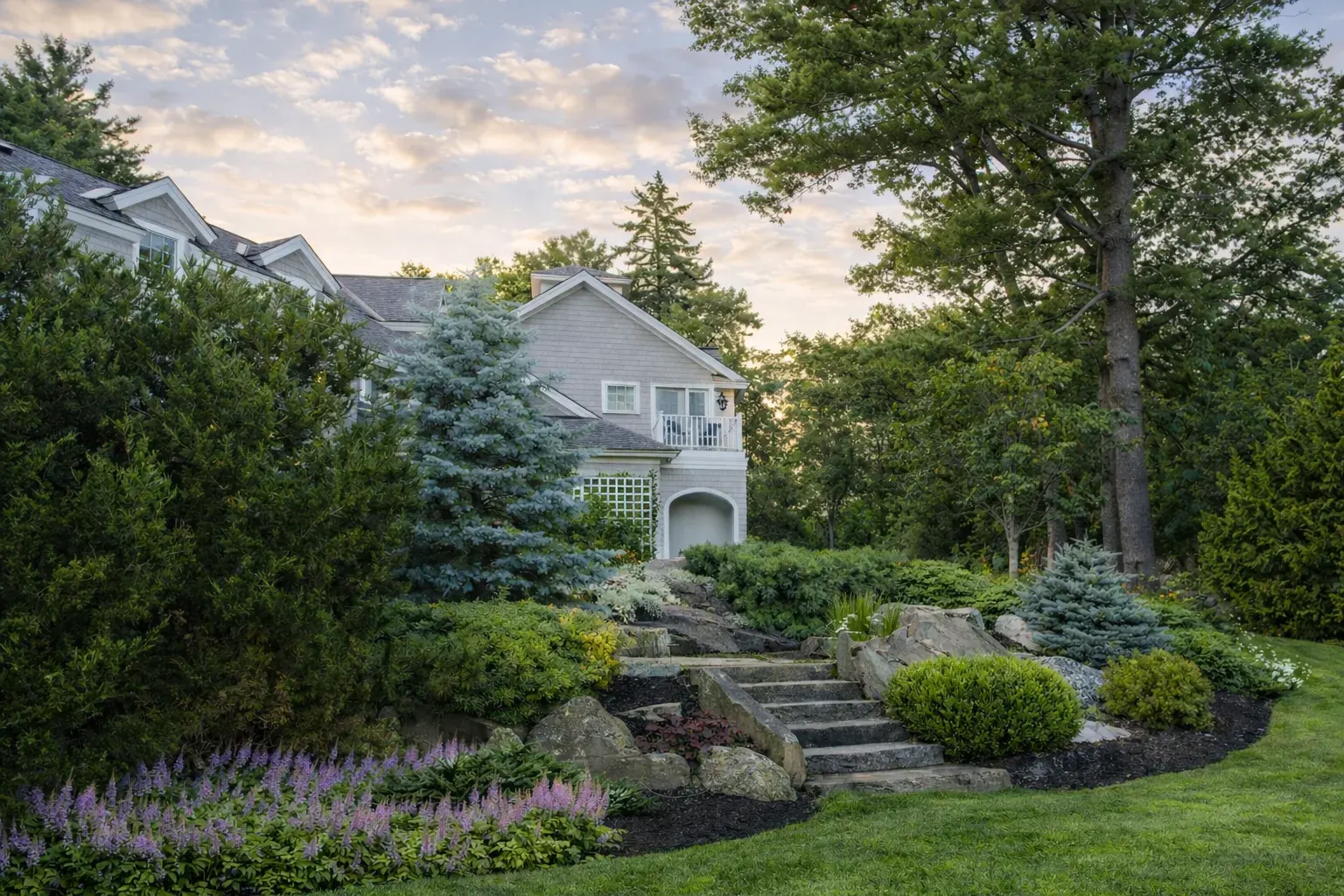
It usually happens halfway through the season. In May, the yard looked full of promise. By late July, water sits near the walkway, shrubs press against the windows, and mowing somehow takes twice as long as it should. That is how most common landscaping mistakes show up, not all at once, but as expensive little frustrations that keep piling on, especially with New Hampshire winters, spring thaw, and short growing windows in places like Meredith, Gilford, and Laconia.
1. Skipping a real landscape plan before you start
The fastest way to spend too much on a landscape is to build it one impulse decision at a time. A patio goes in because the space looks empty. Then a bed gets added to soften the edge. Then a few shrubs get dropped in near the foundation because the front of the house needs something. Months later, nothing quite fits together.
A landscape plan does not need to look like a blueprint pulled from an architect's desk. It just needs to answer the big questions before money starts leaving your account. Where should lawn actually stay lawn? Where do people walk naturally? Where will snow get piled in winter? Where should future projects go so this year's work does not get ripped out next year?
This is one of the most common landscaping mistakes because every later choice depends on it. Planting, grading, lighting, drainage, edging, irrigation, patios, and privacy screening all connect. If the layout is off, every other decision gets harder and more expensive.
What to map before the first shovel goes in
Start with the shape of the property and the spaces you use every week, not the pretty details. Property lines matter. Utilities matter. Septic components, well locations, slopes, low spots, existing trees, sun exposure, and shade patterns all matter too.
Then get practical. Notice where the lawn stays damp after rain. Notice where you cut across the yard instead of following the walkway. Notice which windows need privacy and which ones need more light. A yard should fit your actual routine, not some generic picture from a garden center sign.
The trick is to map both current conditions and future phases. If a fire pit area is probably coming later, leave room for it now. If the side yard needs drainage work next year, do not plant a bed there this year and hope for the best.
How this mistake gets expensive later
Patchwork landscapes waste money in the most annoying ways. You buy plants twice because the first group ended up in the wrong place. Edging gets redone because the bed line looked good from one angle but awkward from the driveway. A patio has to be regraded because runoff was never considered. A walkway gets moved because it does not line up with the entry in a way that feels natural.
None of those fixes are dramatic on paper. Together, they are where budgets quietly disappear.
The catch is that most of this rework was avoidable from the start. A simple plan almost always costs less than redoing finished work.
2. Ignoring drainage and water flow
Drainage problems in the Lakes Region are not subtle. Snowmelt, spring thaw, and a hard summer rain will expose every weak spot in a hurry. If water has nowhere to go, it will sit in the lawn, wash mulch into the driveway, freeze into slick patches on walkways, or push against the foundation.
A lot of landscape problems that look like plant problems are really water problems. Thin turf, stressed shrubs, shifting pavers, muddy bed edges, and moss taking over shady areas often trace back to poor drainage.
Here is the simple rule: water always wins. If the layout ignores that, the yard eventually pays for it.
Warning signs your site is already telling you something
Some warnings are obvious. Puddles that linger for a day or two after rain are a clear message. So are downspouts that dump right beside planting beds or foundation corners.
Other signs are quieter. Maybe one stretch of lawn always feels soft underfoot. Maybe mulch keeps sliding to the same edge. Maybe a narrow channel appears after every storm where runoff cuts through the soil. Maybe moss keeps showing up where you wanted grass.
Those are not random annoyances. They are clues. And if you ignore them before installing a patio, walkway, or fresh planting bed, the problem does not disappear. It just gets buried under a more expensive problem.
Smart planning moves that prevent bigger repairs
Good drainage planning starts with grading, which simply means shaping the ground so water moves away from structures and out of high-use areas. Sometimes that is enough. Sometimes a swale, a shallow, sloped channel that guides water across the property, makes the bigger difference.
In wetter spots, drain tile can help. That sounds technical, but it is just buried perforated pipe that collects and redirects excess water. Dry creek beds can do similar work while also looking intentional instead of purely functional. The point is not to throw products at the problem. The point is to give water a path.
Patios and walks deserve extra attention here. If a hardscape is placed at the bottom of a slope or pitched the wrong way, it becomes a shallow pool or an ice sheet. Neither is fun in January. Planning where water moves before hardscape goes in is much cheaper than trying to fix it afterward.
3. Putting the wrong plant in the wrong place
A shrub that looked perfect in a nursery pot can struggle badly once it meets your actual site. That is because plant choice is not about what looks good on a Saturday in June. It is about what can handle your soil, moisture, winter conditions, wind exposure, and maintenance habits for years.
This is one of the biggest common landscaping mistakes for a reason. Plants are often chosen by appearance first and site conditions second. But survival, health, and long-term looks all depend on the conditions.
A healthy plant in the right location usually needs less pruning, less spraying, less babying, and less replacing. That is not a small benefit. It is the whole game.
Sun, shade, soil, and zone all matter
Start with light. Full sun means many hours of direct sun. Part shade means a gentler mix. Full shade is exactly what it sounds like. If a sun-loving plant gets tucked into a dim foundation corner, it will not become charmingly adaptable. It will get leggy, thin, and disappointing.
Soil matters just as much. Sandy soil drains quickly and dries out faster. Compacted soil holds water and limits root growth. Some plants can handle wet feet. Many cannot. Matching the plant to the soil saves you from the endless loop of replacing things that were never happy there.
Hardiness zone matters too, but it is not the whole story. A plant may technically survive the cold and still hate the spot because of winter wind, road salt, or repeated freeze-thaw swings.
Lakes region factors people forget
Local conditions have a way of humbling generic plant advice. Lake breezes can dry out exposed sites. Plow piles can bury foundation beds in packed snow. Salt splash near driveways can burn foliage and damage roots. Sandy pockets and compacted fill can exist on the same property.
Deer pressure is another reality check. A plant that looks gorgeous for two weeks is not a great choice if it becomes a buffet every evening. The same goes for exposed corners where winter burn takes out broadleaf evergreens year after year.
The trick is to choose plants that want to be in your yard, not plants that need constant rescue. That one decision changes everything.
4. Forgetting how big plants get
Tiny plants are deceptive. A three-gallon shrub looks so manageable at planting time that spacing feels almost silly. Then a few seasons pass, and the bed starts swallowing the walkway, blocking windows, and pressing against siding.
Mature size should drive the layout, not planting-day size. That sounds obvious until you are standing in a nursery with a cart full of small plants and the bed still looks empty. Empty at installation is often exactly right. Landscapes are supposed to grow in.
Why overcrowding creates more than a messy look
Crowding is not just a visual issue. Tight spacing reduces airflow, which encourages mildew, leaf spot, and other disease problems. It also creates damp, shaded pockets where pests thrive and healthy growth gets weaker over time.
Then comes the maintenance spiral. You prune to keep one shrub off the steps. Then you shear another away from the windows. Then you start cutting everything harder just to keep the shape from taking over. Before long, healthy plants are being treated like furniture that needs constant pushing back into place.
Eventually, something has to go. Removing healthy, established plants because the spacing was wrong in the beginning is one of the most frustrating costs in landscaping.
Where spacing mistakes show up most often
Foundation plantings are a big one. Small evergreens and flowering shrubs get installed too close to the house because the bed looks thin on day one. A few years later, air circulation drops, windows disappear, and trimming becomes a seasonal chore.
Privacy screens are another trap. Planting too tightly for instant coverage sounds smart until the plants start competing with each other, thinning out, or growing unevenly. Under-tree plantings also run into trouble fast, especially when roots, shade, and dry soil all compete for space at once.
Entry beds deserve special caution. Overcrowding near the front walk does not just look busy. It makes the whole entrance feel tighter and harder to maintain.
5. Building hardscapes without thinking about function, snow, and maintenance
A patio can be beautiful and still be wrong. The same goes for a walkway, retaining wall, or fire pit area. Hardscapes often get planned for how they will photograph in June, not how they will work in October rain or January snow.
Function should come first. How do you move through the space? Where do guests gather? Where does furniture sit without blocking circulation? Where does meltwater go? If those questions get ignored, the finished project can feel oddly frustrating even when it looks polished.
Hardscape mistakes are expensive because the materials are expensive. Fixing a shrub bed is annoying. Rebuilding a wall base or relaying pavers is something else entirely.
Common hardscape planning misses
Narrow walkways are a classic example. They seem fine until two people try to pass each other, or until snow narrows the usable width even more. Poor step placement causes similar headaches, especially if the rise and run feel awkward underfoot.
Material choice matters too. Some surfaces get slick fast. Some absorb stains or show winter wear more than expected. Privacy is another one people notice too late. A patio set in full view of the driveway or neighboring windows may technically work, but it rarely feels comfortable enough to use often.
Retaining walls deserve extra care because appearance can hide structural problems. If the base is not prepared correctly, shifting, bulging, and drainage issues show up later, often after freeze-thaw cycles do their work.
The winter-use test
Before building anything, picture the space in January. Where will the snow from the walkway get pushed? Will that block a path, bury low plants, or melt back across the pavers and refreeze? Can a shovel move through the route easily, or are there awkward pinch points?
This test catches a lot. Paths that feel generous in summer can feel cramped once snowbanks appear. Steps without good drainage can turn icy. A patio edge may become the exact spot where runoff refreezes overnight.
If a hardscape still makes sense during winter use, that is a good sign the layout is working. If it only works in fair weather, the plan needs another pass.
6. Designing a yard that takes more work than you want to give it
Some landscapes look great right after installation and then slowly turn into a second job. Beds need edging every other week. Fast-growing shrubs need constant trimming. Oversized lawns demand more mowing, more fertilizing, more watering, and more leaf cleanup than anyone really wanted.
Here is the honest part: a lot of people do not want a high-maintenance yard, even if the original design looked appealing. And that is completely fine. A landscape should fit your time and energy, not quietly punish you for having a busy life.
The best low-stress landscapes are not boring. They are just better matched to reality.
Features that quietly create ongoing work
Too many bed edges can turn simple upkeep into a never-ending loop of trimming and redefining lines. Fussy plant mixes often look lively at first, but if every plant wants something different, care becomes a juggling act.
Large lawn areas bring their own workload, especially on properties where growth surges in spring. Gravel areas can also create more maintenance than expected if leaves, weeds, and blown debris settle into them. Plants that need repeated shearing to stay in bounds are another hidden time drain.
None of these choices are wrong on principle. The problem starts when the design asks for more attention than you want to give. That mismatch is where frustration lives.
How to plan for lower-maintenance results
Simpler bed shapes are easier to mow around and easier to mulch. Repeating durable plant choices usually works better than collecting one of everything. Consistent plant palettes also make the yard feel calmer and more put together, which is a nice bonus.
Reducing unnecessary lawn can save serious time, especially in awkward strips and hard-to-mow corners. Mulch helps too, but only when used correctly and refreshed as needed, not piled into volcanoes around trunks or spread as a cure-all.
The big shift is choosing a realistic care level from the beginning. If you do not want to spend Saturdays pruning and fussing, the design should reflect that. A yard that stays attractive with sensible upkeep is far better than one that looks impressive for a month and exhausting after that.
7. Overlooking year-round interest, lighting, and the way the space feels
A yard is not only a summer afternoon project. You see it in mud season, in October, from the kitchen window in November, and during those gray stretches when the flowers are long gone and everything looks a little tired. If the landscape only works at peak bloom, it is incomplete.
The best landscapes feel intentional even when they are quiet. Structure carries the space through the off-season. Lighting extends use and improves safety. A couple of well-placed focal points can make the whole property feel more settled.
This is the kind of planning people often leave for later. Later usually means never.
Beyond summer flowers
Evergreens matter because they keep shape and color in the scene when everything else disappears. Bark texture matters more than most people expect, especially in winter light. Bloom timing matters too, because a yard that has one flashy week and then nothing much happening can feel oddly flat.
Fall color deserves a place in the plan, but so does basic structure. Think about what the yard looks like from the street and from inside the house. That view from the living room in early March counts. A lot.
Even simple choices, like repeating shrubs with strong form or using ornamental grasses where appropriate, can make the space feel composed longer through the year.
Small planning choices that improve daily use
Lighting should not be an afterthought. Path lighting improves safety and helps the yard feel usable after dark. Entry lighting makes the house feel more welcoming and makes winter evenings easier to navigate.
One or two focal points are usually enough. Maybe it is a specimen tree, a boulder placement, a fire pit, or a cleanly framed front entry. Too many focal points compete with each other. A few good ones give the eye somewhere to land.
Seating placement matters in the same quiet way. A chair in full afternoon sun with no privacy sounds nice until nobody uses it. Comfort, shade, and a sense of enclosure make outdoor spaces feel worth spending time in.
A simple way to prioritize fixes before you spend more
If your yard already has a few of these issues, the good news is you do not need to fix everything at once. Start with drainage and grading first. Water problems tend to damage everything around them, so that is the place to get serious.
After that, focus on layout. Make sure paths, beds, lawn areas, and hardscapes fit how you actually use the property. Then deal with plant placement and spacing, because those choices shape how much maintenance and replacement cost you carry later. Appearance details, like lighting, seasonal color, and focal points, come after the bones are right.
Here is the one thing worth trying before making another landscape decision: walk your property right after a heavy rain, or during spring thaw, and write down the first three problem spots you notice. That short walk will tell you more about what needs fixing than another afternoon spent guessing from the driveway.
Disclaimer: This article is for general informational purposes only. It is not professional advice, a quote, or a service agreement. Conditions at your home or property may differ; contact a qualified professional for an on-site evaluation before making repair, safety, or spending decisions.